How to Write AI Voiceover Prompts That Sound Like a Person, Not a Narrator Reading a Script
August 24, 2026 · 7 min read
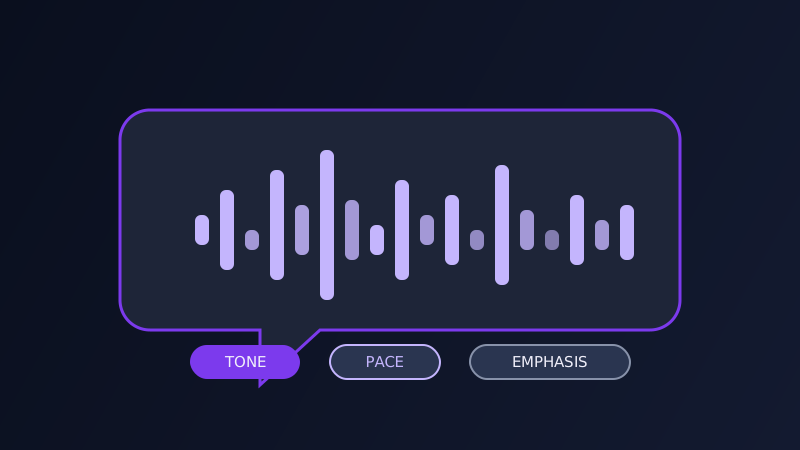
Paste a script into a text-to-speech tool and ask it to read it, and you will usually get exactly that: a clean, competent, entirely flat reading that sounds like nobody in particular narrating nothing in particular. The gap between that default output and a voiceover that actually sounds like a person talking to you, whether that is a warm explainer for a product demo, an energetic read for a fifteen-second ad, or a calm, unhurried narration for an audiobook chapter, comes almost entirely from what the prompt tells the model about delivery, not from the words of the script itself. Most people writing voiceover prompts spend all their effort polishing the script and none on the instructions around it, then wonder why a technically correct reading still sounds like nobody is actually saying it.
Why voiceover prompting is a different job than script writing
A script tells a voice model what to say. A voiceover prompt tells it how to say it, and those are separate jobs that most people accidentally merge into one, writing the script itself and assuming tone will simply follow from the words. It usually will not, not reliably. The same line, 'this changes everything,' can be read as a hushed reveal, a confident sales pitch, or a slightly ironic aside, and a model given only the text has no way to know which one you meant. This is the same gap that shows up in image and video prompting, where describing a scene is not the same as describing how it should feel, except in voiceover the entire deliverable is the delivery. Get the words right and the tone wrong, and you have not produced a slightly worse version of what you wanted, you have produced a different piece of audio entirely.
The instructions that actually shape a reading
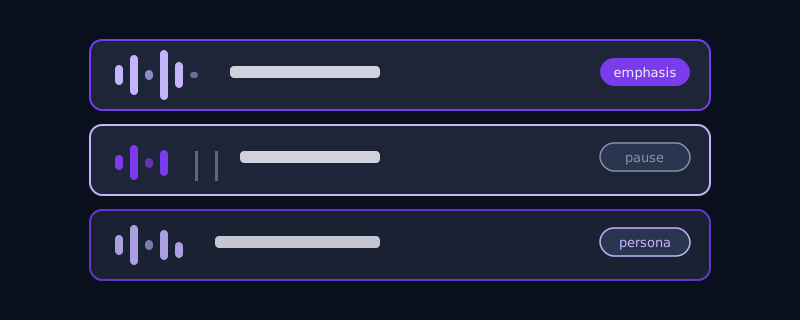
A handful of specific instructions do most of the work, and they are worth separating from the script itself rather than folding into it. Emotional register names the actual feeling you want carried through the read (calm confidence, restrained urgency, warm reassurance) rather than a vague adjective like 'engaging,' which every model interprets differently and none interpret the way you meant. Pacing and pauses matter as much as tone: a voiceover for a fifteen-second ad needs to be told to move quickly with almost no pause, while a meditation or audiobook narration needs explicit instruction to slow down and leave space after key phrases, because a model left to its own judgment tends to default to an even, brisk, radio-announcer pace that fits neither extreme well. Emphasis is worth calling out by name on the specific word or phrase that carries the point of a sentence, since a model reading "we didn't raise the price, we lowered it" with even stress across every word loses the entire point of the sentence. And persona, a short description of who is speaking (a tired but hopeful narrator, a confident product expert, a warm customer support voice), gives the model a consistent character to read as, the same way naming an audience and voice in a marketing prompt keeps the copy from drifting toward a generic register partway through.
What changes across the common voiceover use cases
The right combination of these instructions shifts a lot depending on what the voiceover is actually for, and treating every read as the same job is where a lot of flat output comes from. An ad or UGC-style voiceover usually needs energy and pace named explicitly (upbeat, quick, conversational, like talking to a friend rather than reading copy) along with a note on where the one moment of real emphasis lands, since a fifteen or thirty second spot only has room for one. An explainer or e-learning narration needs the opposite instinct: a slower, more even pace, explicit pauses after each new concept before moving to the next one, and a warmer, more patient tone than an ad would ever want, because the listener is trying to absorb something, not get excited about something. Audiobook or long-form narration benefits most from a consistency instruction, naming the narrator's voice once at the start of the prompt and asking the model to hold that same register across scene changes, rather than letting an unprompted dramatic passage pull the reading into a different, inconsistent tone than the calmer chapters around it. Character or game voice work needs the most explicit persona description of the four, since there is no script convention to fall back on: age, accent register, energy level, and a note on how the character should sound relative to other characters in the same project all belong in the prompt, not left for the model to infer from a name alone.
Common mistakes
Writing tone into the script itself with all-caps or exclamation points instead of naming it directly in the prompt, which models interpret inconsistently and which does not survive a rewrite of the line. Asking for an emotion without naming the specific moment it should apply to, so a note like 'make this sound excited' gets spread evenly across a script that only needed a lift on one closing line, flattening everything around it instead. Skipping a pacing instruction entirely and accepting whatever default pace comes back, then being surprised that a thirty-second ad script reads in fifty seconds, or that a reflective narration rushes past the line that was supposed to land hardest. Describing a persona once at length and never referring back to it in a longer script, letting the read drift toward a generic tone by the middle of a long piece instead of anchoring back to the character named at the start.
A voiceover prompt earns its keep in the instructions that never appear in the script itself: the register, the pace, the one word that should carry more weight than the others, the character reading the whole thing consistently from the first line to the last. Get those specific, and a competent script turns into a reading that actually sounds like someone talking to the listener, not a document being read aloud.
Frequently asked questions
Do I need to describe every line's tone separately, or can I set it once for the whole script?
For a short script, ten to thirty seconds, naming the tone and persona once at the top of the prompt usually carries through the whole read consistently. For anything longer, an explainer, a multi-paragraph narration, an audiobook chapter, name the tone once as a baseline and then call out specific moments that should shift from it (a pause before a key point, more energy on a closing line), rather than re-describing the tone for every sentence, which tends to produce a read that jumps around instead of holding a consistent character.
How specific should pacing instructions actually be?
More specific than most people default to. 'Speak naturally' produces an even, generic pace because the model has nothing to react against. Naming the actual target (a fifteen-second ad that needs to land in fifteen seconds, a meditation narration that should leave a full breath of silence after each instruction) gives the model something concrete to pace against, and it is usually the single instruction that most changes whether a reading sounds rushed, flat, or right.
What's the difference between naming an emotion and naming a persona?
An emotion (calm, urgent, warm) describes the feeling of a specific read or passage. A persona (a tired but hopeful narrator, a confident product expert) describes who is speaking across the whole piece, and it is what keeps a longer script sounding like one consistent voice instead of a series of disconnected emotional beats. Most strong voiceover prompts use both: a persona set once at the top, and specific emotional notes layered on top of it at the moments that need them.
Can Promptima help write prompts for voice and audio tools specifically?
Promptima's prompt generation is built to translate a rough idea, a script you already have and a sense of how it should sound, into the specific delivery instructions a voice or audio tool actually responds to (register, pacing, emphasis, and persona) tuned for the platform you are using, rather than leaving you to guess which words a given tool interprets as tone versus which ones it just reads aloud.
Try Promptima's prompt generator for voice and audio scripts, delivery instructions included →
✦ Try Promptima freeMore articles

Best AI Prompt Optimizer Tools in 2026 (And When to Use Each)
Prompt marketplaces, browser extensions, manual prompt engineering, and dedicated optimizers all solve a different version of the same problem. Here is how to tell which one you actually need.
How to Turn One Photo Into a Ready-to-Use AI Video Prompt
You have an image whose look you want to bring to life as a video. The problem is that video AI tools don’t read image prompts — they need camera, motion, and duration described in a completely different structure. Here’s how to bridge the two.