How to Turn One Photo Into a Ready-to-Use AI Video Prompt
July 21, 2026 · 8 min read
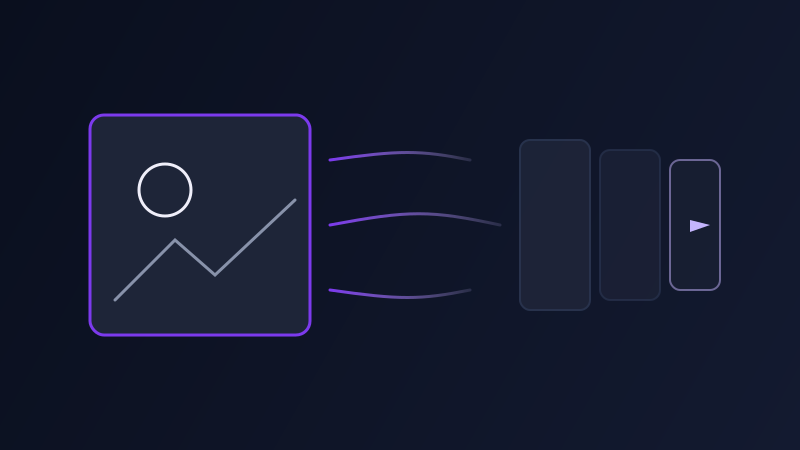
A common moment for anyone using AI image tools: you land on an image whose lighting, mood, or composition is exactly right, and the next thought is "I want this moving." The instinct is to paste the image prompt into a video tool and hope. It rarely works, because image prompts and video prompts are not the same language — an image prompt describes a single frozen frame, while a video prompt has to describe what happens across time, and that requires information the image prompt never had a reason to include.
Why the same prompt doesn’t just work for video
An image prompt like "elderly fisherman mending nets on a wooden dock, oil painting, warm golden hour light" fully describes a still frame. A video tool reading that same prompt has to guess: does the camera move? Does the fisherman’s hand move, or is he static? How long is the shot? What happens in the last second versus the first? None of that is answered by a prompt written for a still image, so the video tool fills the gaps with generic defaults — which is why image-to-video attempts using the original image prompt so often come back flat or oddly static.
The four things a video prompt needs that an image prompt doesn’t
Camera movement: a single specific move (slow push-in, orbit, static shot), not a vague "cinematic camera." Subject motion: what specifically moves and how — hands, fabric, water, hair — versus what stays still. Duration and pacing: most video tools want an explicit shot length, and some (like Seedance) want the whole clip broken into numbered shots with an escalation arc. Temporal detail: what changes between the start and end of the clip, since a video prompt describing only the opening frame produces a clip that barely moves.
The manual process
Start from the image and describe it fully — subject, setting, lighting, mood — exactly as you would for an image prompt. Then add a camera layer: pick one movement, not three. Then add a motion layer: name the one or two things in frame that should move, and roughly how. Then match the structure to your tool: Sora and Veo want flowing cinematic prose describing the whole scene; Seedance wants a numbered shot list starting with "[X] shots, [duration], [aspect ratio]"; Runway rewards economy and a clear single camera direction up front.

A worked example
Starting image prompt: "woman in red coat standing under a streetlamp in the rain, cinematic lighting, teal-orange color grade." Converted to a Sora-style video prompt: "A woman in a red coat stands beneath a streetlamp as rain falls steadily around her. The camera slowly pushes in from a wide shot to a medium close-up as she looks up, rain visible in the light beam. Her coat shifts slightly in the wind. Teal-orange cinematic color grade, 24fps, natural film grain." Same subject and mood, but now the clip has something to actually animate: a camera move, a motion cue, and enough scene detail to sustain several seconds instead of one frame.
Where this gets tedious, and where Prompt Chains skips it
Doing this conversion by hand for every image you like means re-describing a scene you already have, guessing at camera and motion language you may not use daily, and reformatting the whole thing per video tool. Promptima’s Prompt Chains feature does this conversion directly: after analyzing an uploaded image, one click carries that analysis — composition, lighting, mood — straight into the video prompt generator, which then asks only for the camera move, duration, and target tool (Sora, Veo, Runway, Kling, Higgsfield, or Seedance) before generating the tool-specific prompt. No re-describing the image, no copy-paste between tools.
Common mistakes
Naming three camera moves instead of one — video AI tools follow a single clear direction far more reliably than a stacked list. Describing only the first frame and assuming the tool will invent the rest — it usually invents something generic instead. Using an image-tool aspect ratio flag (like Midjourney’s --ar) in a video prompt, which most video tools don’t parse the same way. Skipping duration entirely and being surprised the pacing feels off — most tools default to something shorter than you’d expect.
Frequently asked questions
Can I use my Midjourney prompt directly in a video AI tool?
Not effectively — image prompts describe a single frame, while video prompts need camera movement, motion cues, and duration that an image prompt was never written to include. You can reuse the subject, style, and lighting description as a starting point, but you need to add a camera and motion layer for a video tool to produce something that actually moves in an intentional way.
What information does a video prompt need that an image prompt doesn’t?
Four things: a specific camera movement, what moves in the scene and how, the shot duration, and what changes between the start and end of the clip. Image prompts only need to describe a single static frame, so they typically include none of this.
Which AI video tools need the most different prompt structure?
Seedance requires the most distinct format — a numbered shot list starting with shot count, duration, and aspect ratio. Sora and Veo prefer flowing cinematic prose describing the whole scene. Runway rewards a short, direct camera instruction up front. Using one tool’s format in another usually produces weaker results than using each tool’s native structure.
Is there a faster way to convert an image into a video prompt than doing it manually?
Promptima’s Prompt Chains feature carries an uploaded image’s analysis (composition, lighting, mood) directly into its video prompt generator in one click, then asks only for camera move, duration, and target tool — skipping the manual re-description and per-tool reformatting described above.
Try Prompt Chains — image to video in one click →
✦ Try Promptima freeMore articles
Best AI Prompt Optimizer Tools in 2026 (And When to Use Each)
Prompt marketplaces, browser extensions, manual prompt engineering, and dedicated optimizers all solve a different version of the same problem. Here is how to tell which one you actually need.
Midjourney vs DALL-E vs Stable Diffusion vs Firefly: How Image AI Prompts Actually Differ
Midjourney, DALL-E, Stable Diffusion, and Adobe Firefly all read prompts differently — the same words that produce a great Midjourney image can get read as literal text somewhere else. Here is what actually changes, tool by tool, and how to translate a prompt between them.