How to Write AI Prompts for Book Cover Design That Don't Look Like Generic Stock Art
September 7, 2026 · 8 min read

A book cover prompt that just describes the story (a woman discovers a hidden door in her family's old house) tends to come back as a competent, generic illustration of a scene, the kind of image that could be the cover of a dozen different books or none of them. Readers do not judge a cover on whether it depicts a scene from the book accurately, they judge it in about half a second on whether it signals the right genre and looks like it belongs on a shelf next to the books it is competing with, and that is a completely different job from illustrating a moment in the story, one a plot-description prompt was never built to do.
Why book covers need a different prompt than other illustrations
Most image prompts are judged on whether the result looks good. A book cover prompt is judged on a narrower, harder question: does it look like it belongs to its genre, at a glance, from across a room or a two-inch thumbnail on a retail page. A fantasy cover and a literary-fiction cover can both be beautifully composed and still fail completely if a fantasy reader looks at the literary cover and assumes it is a memoir, or a thriller reader scrolls past a moody, painterly cover because nothing in it reads as suspense. This is a convention problem before it is a composition problem, and a prompt that only describes what happens in the scene never tells the model which convention it is supposed to be signaling.
The details a cover prompt needs that a plot summary doesn't
Genre convention, named directly rather than implied by the scene: a thriller reads through high contrast, a single ominous object or silhouette, and a tight, close crop, while a cozy mystery reads through warm color, a charming illustrated scene, and visible detail across the whole frame. Naming the genre by its visual convention, not just its label, gets a far more useful result than the word 'mystery' on its own, since the model otherwise has to guess which of several very different mystery sub-genres you mean. A single strong focal element instead of a busy scene: the most recognizable covers usually center on one object, one figure, or one symbol rather than a fully staged moment, because a cover has to read at thumbnail size, and a complex scene collapses into noise at that size while a single clear silhouette does not. Negative space reserved for type: a working cover needs a real, described area, usually the top third or a clear band across the middle, left deliberately simple enough for a title and author name to sit on top of it, which a prompt focused purely on the illustration will never account for on its own. And a color palette tied to the genre's mood rather than to the literal scene: a thriller's palette is about tension (desaturated, high contrast, one accent color) more than it is about what color the actual objects in the scene would be in real life.
Matching the prompt to the genre
A thriller or suspense cover wants a tight, dramatic crop on one ominous object or a partial figure, desaturated color with a single sharp accent, and a mood built on tension rather than detail. A fantasy cover wants a wider, more atmospheric composition, often with a landscape or a symbolic object rendered in rich, saturated color, and enough visual complexity to reward a longer look once someone has already picked it up. A romance cover wants warmer, softer color, often centered on two figures or a single evocative object (a letter, a ring, a doorway), with enough open space at the top for a prominent title, since romance covers typically lead with type more than most other genres do. A literary fiction cover wants restraint above almost anything else: a single symbolic image, muted or unexpected color, and enough negative space that the cover reads as understated rather than illustrated, which is often the opposite instinct of what a plot-description prompt naturally produces. A self-help or business nonfiction cover wants almost no scene at all, a clean, abstract or geometric visual built around a strong central image or a bold color block, since this category signals credibility through simplicity rather than through story.
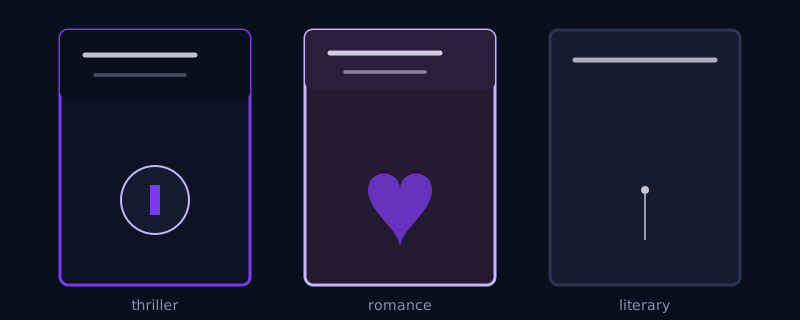
A worked example
A generic prompt: 'a book cover about a detective solving a murder in a small coastal town.' Typical result: a competent illustrated scene of a detective on a foggy dock, technically fine and impossible to place in any specific mystery sub-genre, with no obvious space for a title. A prompt built the way described above: 'Book cover for a literary crime thriller. Single focal element: a lit lighthouse window seen from a dark shoreline, no figures. Desaturated blue and grey palette with one warm amber accent from the window light. Tight vertical crop, moody and restrained rather than illustrated. Leave the top third of the frame dark and simple enough for title text to sit on it.' The result signals literary crime rather than cozy mystery through the palette and restraint alone, centers on one image instead of a busy scene, and actually leaves room for the words that have to go on top of it.
Common mistakes
Prompting from the plot instead of the genre, which produces an accurate illustration of a scene that could belong to any book in the category or none of it. Asking for a fully detailed, busy composition without accounting for the fact that a cover has to read clearly at thumbnail size, where a complex scene collapses into visual noise. Forgetting to reserve space for the title and author name, then finding out later that no version of the generated image has anywhere for text to actually sit without covering the main subject. Choosing a color palette based on what the objects in the scene would look like in reality rather than what mood the genre expects, which is how a suspense novel ends up with a bright, cheerful cover that undersells exactly the feeling it is trying to create.
A book cover prompt is doing a signaling job before it is doing an illustration job: it has to tell a reader what shelf this book belongs on before they ever read the description, and it has to leave physical room for the words that turn an image into an actual cover. Naming the genre convention, choosing one focal element instead of a full scene, and reserving space for type are what get a generated cover closer to something that could actually go to print, rather than a nice picture that happens to relate to the story.
Frequently asked questions
Why does my AI-generated book cover look generic even though it matches the story?
Because a prompt built from the plot describes a scene, not a genre signal, and readers judge a cover on whether it reads as the right genre at a glance, not on whether it accurately depicts a moment from the book. Naming the genre's actual visual convention (contrast, color mood, composition) rather than just the scene gets a far more specific result.
How much of the cover should be left empty for the title?
Enough that a real title and author name could sit on it without covering the main subject, usually a full third of the frame kept deliberately simple, most often across the top or in a clear band through the middle. A prompt that only describes the illustration will not account for this unless it is asked for directly.
Does the color palette matter more than the actual scene content?
For genre signaling, often yes. A thriller's desaturated, high-contrast palette with one sharp accent color communicates the genre faster than the literal objects in the scene do, and a technically accurate scene rendered in the wrong mood of color can undersell or misrepresent the genre entirely.
Can Promptima generate book cover prompts for a specific genre?
Promptima's prompt generation can build a cover prompt around genre convention, a single focal element, palette, and reserved space for type, tuned to whether the book is a thriller, fantasy, romance, literary fiction, or nonfiction title, rather than producing the same illustrated-scene prompt regardless of genre.
Try Promptima's prompt generator for book covers, genre convention and type space included →
✦ Try Promptima freeMore articles

Best AI Prompt Optimizer Tools in 2026 (And When to Use Each)
Prompt marketplaces, browser extensions, manual prompt engineering, and dedicated optimizers all solve a different version of the same problem. Here is how to tell which one you actually need.

How to Turn One Photo Into a Ready-to-Use AI Video Prompt
You have an image whose look you want to bring to life as a video. The problem is that video AI tools don’t read image prompts — they need camera, motion, and duration described in a completely different structure. Here’s how to bridge the two.