How to Write AI Prompts for Content and Blog Writing That Doesn’t Read Like Everyone Else’s AI Post
August 6, 2026 · 9 min read
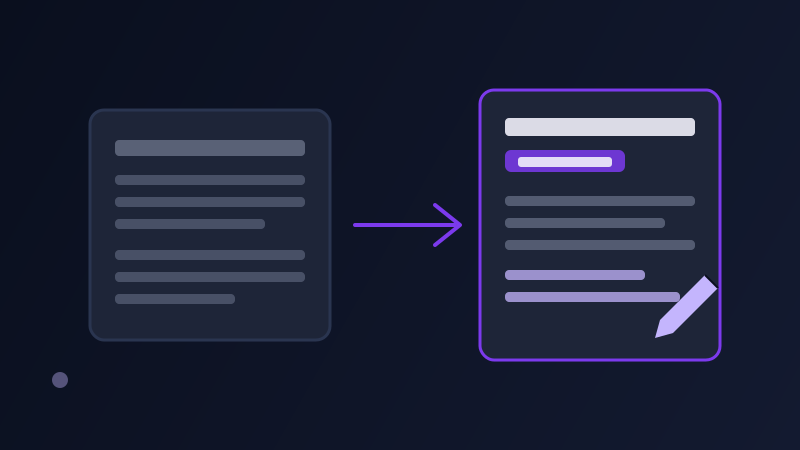
Ask an AI tool to "write a blog post about remote work productivity" and you will get something publishable in the loosest sense: an introduction that restates the topic, three or four sections with header-cased subheadings, a conclusion that summarizes what was just said, and a closing line about the future or the importance of adapting. It reads fine. It also reads like the same post written for a hundred other blogs on the same topic, because a vague prompt gives the model nothing to write from except the most common shape a blog post about that topic tends to take.
Why AI blog posts all sound the same
A language model without a specific angle, audience, or point of view has to default to the most generic, broadly applicable version of the topic it has been trained on, which produces competent but forgettable writing almost by construction. There is no wrong information in a post like this, and that is part of the problem: it says nothing a reader couldn’t have guessed before clicking, because the prompt never gave the model a reason to say anything more specific than that. The fix isn’t asking for "more engaging" or "more original" writing in the prompt, since those are exactly the kind of vague instructions that produce more generic filler rather than less. The fix is supplying the specific inputs that make generic writing impossible to produce.
The five layers a content prompt needs
A real angle, not just a topic: "remote work productivity" is a topic; "why remote workers overestimate how much an open calendar actually helps them focus" is an angle, and only the second one gives the model something to actually argue rather than summarize. A named audience: who is reading this and what do they already know, since a post for someone new to a subject and a post for an expert reader need entirely different assumptions and entirely different sentences. A point of view: does this post agree with the conventional wisdom on the topic, push back on it, or complicate it, because a post with no stance defaults to restating the middle-of-the-road version of whatever the model has seen most often. Structural constraints: how long, how many sections, whether it needs subheadings, whether it opens with a story, a stat, or a direct claim, since the model will pick the most common shape by default if none of this is specified. A real example of the voice: a paragraph or two you have actually published or written, which does more to fix generic-sounding prose than any adjective-based description of tone ever will.
Four content writing tasks worth knowing how to structure
A blog post from scratch: give the model the angle, the audience, and the point of view before asking it to write anything, and ask for an outline first rather than a full draft, since reviewing and adjusting an outline is far cheaper than reviewing and rewriting three thousand words built on the wrong angle. Rewriting a rough draft: paste your own draft and ask specifically what to improve (clarity, pacing, redundant sentences) rather than "make this better," which invites the model to rewrite the whole thing in its own generic voice instead of sharpening the one you already have. A headline or title: ask for ten options with an explicit constraint to vary the approach (a direct claim, a question, a number, a contrarian angle), since a single request tends to produce the safest, most forgettable option available. An introduction specifically: state what the introduction needs to accomplish (hook a skeptical reader, set up the argument, avoid restating the title in different words) rather than asking generically for "a good intro," which is the section most likely to open with a throat-clearing sentence nobody needed.
Show the voice instead of describing it
Telling a model your writing is "conversational but authoritative" produces prose that is technically consistent with those two words and still reads like every other brand that described itself the same way. Pasting two or three paragraphs you have actually written, ones that sound like you when you read them back, and asking the model to match that voice specifically produces something closer to your actual writing, because it is matching a real pattern instead of interpreting an abstract label. This is the single highest-leverage addition to a content prompt, and it costs nothing beyond finding a paragraph you already have sitting somewhere.
A worked example, before and after
Weak prompt: "write a blog post about the benefits of morning routines." No angle beyond the topic itself, no audience, no stance, no structure, so the model reaches for the five most common benefits anyone has ever attached to a morning routine and lists them with a subheading each. Structured prompt: "Write a blog post arguing that most morning routine advice fails because it copies someone else’s schedule instead of someone else’s constraints. Audience: people who have tried and abandoned a morning routine at least once. Open with a short, specific scenario, not a statistic. Include one section acknowledging why the standard advice (wake at 5am, journal, cold plunge) doesn’t fail because of laziness but because of mismatched constraints. Close without a generic call to action, end on the argument itself. Around 700 words, three sections, no subheading that just restates its section’s first sentence." The second version gives the model an actual claim to defend, a reader to write for, and an explicit shape, leaving very little room to default to the generic five-benefits list.
Common mistakes
Asking for a topic instead of an angle, which gives the model nothing to argue and produces a summary instead of a real piece of writing. Requesting "engaging" or "original" writing as if those words were instructions rather than the result you are hoping for, when what actually produces engagement is a specific angle and a real point of view. Describing your voice in adjectives instead of pasting an example of it. Asking for a full draft immediately instead of an outline first, then discovering three thousand words in that the angle was wrong all along.
None of this makes AI-assisted writing indistinguishable from a piece written entirely by hand, and it isn’t meant to. What it does is remove the specific reason AI blog posts tend to sound alike: a vague prompt with no angle, no audience, and no stance, asked to fill in every gap with the most statistically ordinary version of the topic it has seen. Give it those inputs and the output stops being the same post everyone else’s vague prompt produced.
Frequently asked questions
Why does AI-written content sound so similar across different blogs?
A vague prompt gives the model no specific angle, audience, or point of view to write from, so it defaults to the most common, broadly applicable version of the topic it has seen, which tends to produce competent but forgettable writing that could describe almost any blog covering the same subject.
What is the difference between a topic and an angle?
A topic is the general subject, like remote work productivity. An angle is a specific, arguable claim about that subject, like why remote workers overestimate how much an open calendar actually helps them focus. A model given only a topic can summarize; a model given an angle can actually argue something.
Should I describe my writing voice or show an example of it?
Showing an example works better. Adjectives like conversational or authoritative get interpreted through the model’s own generic idea of those words, while a paragraph you have actually written gives it a real pattern to match instead of a label to guess at.
Should I ask for a full blog post draft right away?
Asking for an outline first is usually more efficient. Reviewing and correcting an outline costs a few minutes; reviewing and rewriting a full draft built on the wrong angle or structure costs considerably more, and the mistake is often easier to spot before the draft exists than after.
Try Promptima’s Creative Writing prompt category free →
✦ Try Promptima freeMore articles

Best AI Prompt Optimizer Tools in 2026 (And When to Use Each)
Prompt marketplaces, browser extensions, manual prompt engineering, and dedicated optimizers all solve a different version of the same problem. Here is how to tell which one you actually need.

How to Turn One Photo Into a Ready-to-Use AI Video Prompt
You have an image whose look you want to bring to life as a video. The problem is that video AI tools don’t read image prompts — they need camera, motion, and duration described in a completely different structure. Here’s how to bridge the two.