Single-Shot Prompting vs. Iterative Refinement vs. Prompt Chains: Three Ways to Get to a Finished AI Result
August 21, 2026 · 9 min read
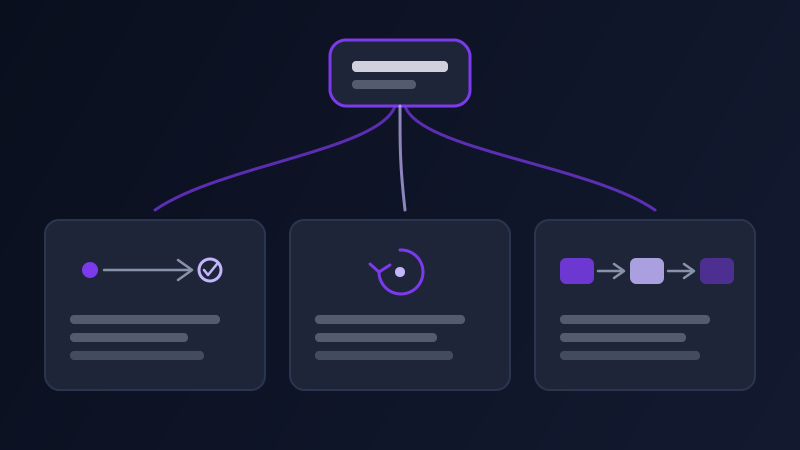
Ask three people how they actually get a usable result out of an AI tool and you will hear three different workflows, all of which count as "prompting" in the loosest sense. One writes a single, carefully built prompt and expects the first thing that comes back to be the final answer. Another writes a rough prompt on purpose, looks at what comes back, and adjusts — sometimes five or six times — before landing on something worth keeping. A third breaks the job into stages, where one prompt’s output becomes the next prompt’s input, so no single request has to carry the whole task by itself. None of these three is the "correct" way to prompt. Each is a different bet about where your effort actually needs to go, and picking the wrong one for a given task is a common, avoidable reason a project takes far longer than it should, or never quite gets there at all.
Three different bets on where your effort goes
The three approaches split along one real question: how much do you already know about what "right" looks like before you start typing? Single-shot prompting is a bet that you know enough right now — the format, the audience, the constraints — to specify a correct result in one pass, so all the effort goes into the prompt itself, up front, before any output exists. Iterative refinement is a bet that you will not fully know what is wrong until you see something, so the effort goes into a feedback loop instead — write, look, adjust, look again — spread across several small, cheap rounds rather than one expensive one. Prompt chaining is a different kind of bet entirely: not that the first attempt might be wrong, but that the finished result genuinely requires more than one kind of output, each built on the last, so the effort goes into connecting stages rather than perfecting any single one. Mixing these up — iterating on a task a chain was built for, or chaining a task that just needed one better prompt — is where most of the wasted time in a multi-step AI project actually comes from.
Single-shot prompting: fast, and it lives or dies on what you already knew
A single-shot prompt is one request, taken as final: you write it once, submit it, and use whatever comes back without a planned round of adjustment. It is the fastest of the three by a wide margin, and it works precisely as well as your ability to specify the task completely before the model has produced anything for you to react to. A prompt that already states the audience, the format, the tone, the length, and the constraints — the kind of structured prompt covered across most of the task-specific guides on this site — genuinely can land correctly the first time, because there was nothing left for the model to guess at. This is why single-shot prompting works especially well for tasks with an objectively checkable target: a JSON object with a defined schema, a resume bullet built around a real number you already supplied, a clause explanation scoped to a named jurisdiction. There is a right shape for the answer, you already described it, and the model either hit it or did not. The failure mode is just as specific: a single-shot prompt on a task you did not actually have fully specified yet produces a confident, complete-looking answer that is wrong in a way you only notice after using it, and by then the cost of the mistake is much higher than it would have been if you had built in a chance to catch it earlier.
Iterative refinement: the first output is information, not a deliverable
Iterative refinement treats the first response as data about your own prompt rather than a finished result — you write something looser than a single-shot prompt on purpose, see what the model actually produced, and use the gap between that and what you wanted to make one targeted change before trying again. This is the right approach for anything with a genuinely subjective or hard-to-pre-specify target: an image’s mood, a video’s pacing, a paragraph’s voice. You often cannot fully describe "the right amount of warmth in this lighting" or "the right level of playfulness in this line" in a first prompt, because you do not know exactly what you mean until you see a version that is close and can point at what is still off. The discipline that makes iterative refinement actually converge, instead of drifting sideways for ten rounds, is changing one variable at a time and keeping everything that already worked: if a Midjourney image has the right subject and the wrong lighting, the next prompt should touch only the lighting clause, not get rewritten from scratch, because rewriting from scratch throws away the parts of the previous attempt that were already correct and reintroduces randomness you had already resolved. The same logic applies to a chat model refining a paragraph’s tone, or a video tool refining a camera move on the second generation of the same clip — each round should be a small, deliberate edit against a known-good baseline, not a fresh attempt that happens to share a topic with the last one.
Prompt chains: when the next step needs a different kind of output entirely
Prompt chaining looks similar to iterative refinement from a distance — multiple prompts, one after another — but it is solving a different problem. Refinement stays inside one kind of output, correcting it toward something better. A chain moves from one kind of output to a structurally different one, where the first stage’s result becomes raw material for a second stage that could not have started from scratch nearly as well. Turning a photo you already generated into a video is the clearest example: the image prompt fully describes a single frame — subject, lighting, mood — and a video prompt needs camera movement, motion, and duration on top of all of that, information the image stage never had a reason to produce. Redescribing the photo from memory to start the video prompt wastes everything the first stage already established and risks describing it slightly differently the second time. Carrying that first stage’s actual analysis directly into the second prompt, the way Promptima’s Prompt Chains feature does by passing an uploaded image’s composition and lighting straight into its video prompt generator, skips the redescription step entirely and only asks for the new information the second stage actually needs: camera move, duration, target tool. The same shape shows up outside video — a data analysis stage that establishes what a spreadsheet’s columns actually mean, chained into a second prompt that builds a chart for a specific audience, or an outline stage chained into a full-draft stage, is doing the same kind of work: not fixing an attempt, but handing a second, different task the context the first one already built.
How to tell which approach a task actually needs
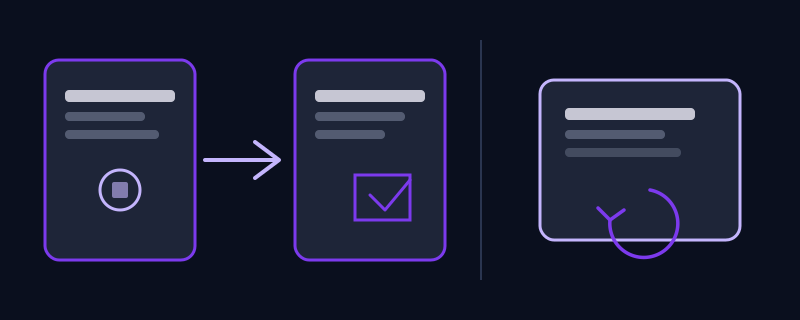
Three questions cut through most of the guesswork. Do you already know, precisely, the format, audience, and constraints before you write the first word? If describing the correct output completely is something you can already do, a single well-built prompt is usually enough, and adding a planned refinement loop on top of it mostly just adds time without adding quality. Will you only recognize whether it is right once you can see it, and is part of "right" genuinely subjective — a mood, a tone, a pace? That is iterative refinement’s job, and it is worth budgeting for a handful of small rounds rather than expecting one prompt to guess your taste correctly on the first try. Does the finished deliverable actually require a different kind of output than what you are starting from — an image becoming a video, a rough idea becoming a structured outline becoming a full draft, a spreadsheet becoming a chart built for one specific audience? That is a chain, and trying to compress it into one giant prompt usually produces a worse version of both stages than handling them separately would.
Where the three approaches combine on a real project
Most real projects use more than one of these, in sequence, rather than picking exactly one for the whole thing. A product launch video is a reasonable example of all three showing up in one workflow. The UGC-style script naming the persona, the hook, the length, and the tone can genuinely be single-shot, since a well-structured script prompt with every constraint already stated tends to land correctly the first time, the same way a legal clause explanation does when the jurisdiction and document type are already specified. The actual video generation from that script’s matching visual concept is a better fit for iterative refinement — the first generation’s camera pacing might be a beat too slow, worth one targeted adjustment rather than a full prompt rewrite, and a second or third round to get the timing right is normal, not a sign the first prompt failed. And if that video starts from a product photo that was generated or selected earlier, carrying that photo’s composition and lighting into the video prompt is a chain, not a refinement — the video stage needs categorically different information than the photo stage produced, not a corrected version of the same information. Two anti-patterns show up when this gets confused: iteratively refining a single giant prompt that is actually trying to do a chain’s job, tweaking word choice round after round without ever fixing the real problem, which is that one prompt is being asked to do two structurally different jobs at once; and accepting a single-shot or chained result without ever evaluating it against a subjective target that genuinely needed a look-and-adjust pass, which tends to produce something technically complete and quietly generic.
Common mistakes
Rewriting an entire prompt from scratch on each refinement round instead of changing one variable and keeping what already worked, which throws away progress and reintroduces the randomness you had already resolved. Trying to make one long, single-shot prompt do a chain’s job — describing a static image and its motion and its duration all in one pass for a tool that generates a single frame — instead of letting an image stage’s result feed directly into a video stage built for that different task. Treating a subjective, taste-dependent target as if it were a single-shot task, accepting the first version of a mood, tone, or pacing without a planned round of adjustment, and settling for competent instead of right. Assuming more refinement rounds are always better: past the point where an output matches what you actually wanted, additional rounds mostly just add drift, since each new adjustment risks disturbing something that was already correct.
None of these three is a more advanced or more professional way to prompt than the others — they are suited to different shapes of task, and the fastest way to waste time on any of them is applying the wrong one. A precisely specified task does not need a refinement loop it will never use. A subjective, taste-dependent one does not need to be single-shot and hoped for. And a task that is genuinely two different kinds of output stacked together does not need to be squeezed into one prompt that cannot hold both jobs at once. Matching the approach to the actual shape of what you are building is most of the work; the prompt text itself is what is left over once that decision is already made.
Frequently asked questions
What is the actual difference between iterative refinement and prompt chaining?
Iterative refinement stays inside one kind of output and corrects it toward what you wanted — a second attempt at the same image, the same paragraph, the same video clip. Prompt chaining moves from one kind of output to a structurally different one, where the first stage’s result becomes the input to a second stage that needed different information entirely, like a still image’s composition and lighting feeding into a video prompt that also needs camera movement and duration. Refinement fixes an attempt; a chain hands off to a different task.
When is a single prompt actually enough, with no refinement or chaining needed?
When you can already specify the format, audience, and constraints completely before you start — a JSON object with a defined schema, a resume bullet built around a real number, a clause explanation scoped to a named jurisdiction. If there is an objectively checkable target and you already know what it is, single-shot prompting usually gets there directly, and adding a planned refinement loop on top of it mostly adds time without adding quality.
How many rounds of iterative refinement is normal before something is wrong with the prompt itself, not just the output?
There is no fixed number, but a useful signal is whether each round is converging — getting closer to the target with a smaller, more specific change — or drifting sideways, where each new attempt fixes one thing and breaks another. Drifting sideways for several rounds in a row usually means the underlying prompt needs a real rewrite, not another small adjustment, or that the task was better suited to a chain than to refinement in the first place.
Can Promptima help with all three approaches, or just one?
Promptima’s core prompt generation is built for getting a strong single-shot result on the first attempt by structuring the details a task needs up front, and its Prompt Chains feature is built specifically for the handoff case — carrying one stage’s result, like an analyzed image, directly into a connected second prompt, such as a video generator, instead of redescribing it from scratch. Iterative refinement itself is still a manual loop you run — adjusting one thing at a time between generations — but starting each round from a more complete, structured prompt makes that loop converge faster.
Try Promptima’s Prompt Chains — build on a result instead of starting over →
✦ Try Promptima freeMore articles

Best AI Prompt Optimizer Tools in 2026 (And When to Use Each)
Prompt marketplaces, browser extensions, manual prompt engineering, and dedicated optimizers all solve a different version of the same problem. Here is how to tell which one you actually need.
How to Turn One Photo Into a Ready-to-Use AI Video Prompt
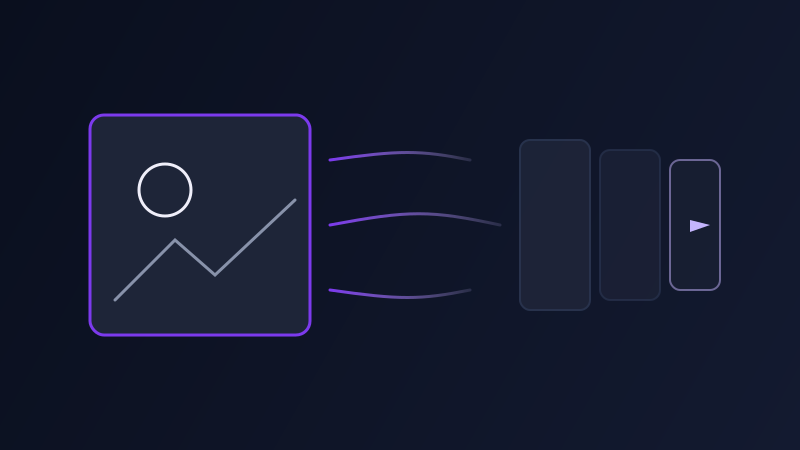
You have an image whose look you want to bring to life as a video. The problem is that video AI tools don’t read image prompts — they need camera, motion, and duration described in a completely different structure. Here’s how to bridge the two.