How to Write AI Prompts for Social Media Captions and Short-Form Video Hooks
August 31, 2026 · 8 min read

Most prompting advice for writing treats a caption like a very short blog post: give it a topic, ask for something engaging, and expect a few polished sentences back. That approach produces text that is grammatically fine and completely ignorable, because a caption and a blog paragraph are not solving the same problem. A blog paragraph gets read by someone who already decided to read it. A caption, and especially a short-form video hook, has to earn that decision in under a second, and nothing in a generic writing prompt asks the model to do that.
The job a caption prompt has to do that a blog prompt does not
A blog prompt can optimize for completeness: cover the topic, structure it clearly, land the point. A caption prompt has to optimize for something else entirely first: stopping a thumb mid-scroll before the reader has decided whether your post is worth their next half second. Everything else, the value in the middle, the call to action at the end, only matters if the first line already did that job. Ask a model for "an engaging caption" and it will write competent, forgettable sentences, because nothing in the instruction told it that line one has a different, harder task than lines two through five.
Writing a hook prompt for short-form video
On TikTok, Reels, and Shorts, the hook is not a caption at all, it is the first one to two seconds of spoken or on-screen text, and it has almost the entire job of keeping someone watching. A prompt that asks generically for "an engaging opening" gives the model no real direction. A prompt that specifies the hook type does: a direct question aimed at the viewer, a contrarian statement that pushes against a common assumption, a before-and-after tease that withholds the payoff, or a specific number-based claim. Naming the type of hook gives the model an actual structure to write toward instead of a vague quality to aim for.
Platform differences that change the prompt
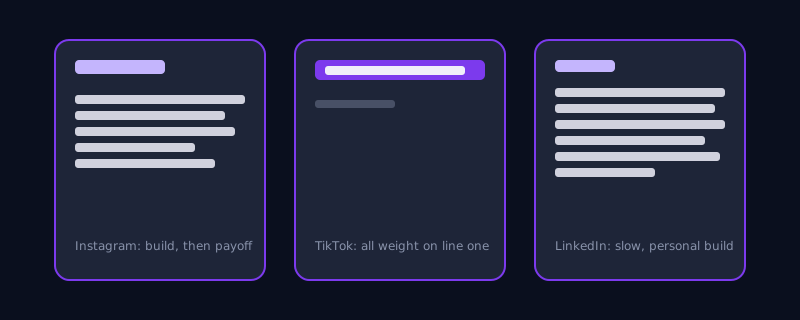
Instagram captions can run longer and support a small narrative arc, a setup with a payoff that lands after the line break where the platform truncates text behind a "more" tap, so a caption prompt for Instagram benefits from specifying where that natural break should sit. TikTok and Reels hooks are almost entirely about the first line, since the video itself carries the rest of the attention once someone is watching. LinkedIn text posts reward the opposite instinct: a slower build with a specific, personal detail stated up front tends to outperform a punchy hook there, since that audience reads speed as a sales pitch and rewards what reads as earned expertise instead.
Giving the prompt something real to work with
A caption prompt fails most often not because of structure but because it has nothing specific to build around. Asking generically to "write a caption about my new product" returns generic marketing language, because there is nothing concrete in the prompt for the model to open with. Giving it an actual detail instead, a specific customer reaction, a real number, a genuine before-and-after, gives the hook something to state plainly rather than something to decorate with adjectives. The difference between a caption that works and one that does not is usually not the writing, it is whether the prompt handed the model a real fact to lead with.
Building a repeatable voice without sounding templated
Accounts posting daily benefit from a reusable caption shape (hook, one line of value, one line of personality, a call to action), but the prompt needs to keep the fixed structure separate from the variable content, or every post starts sounding like a mail merge with different nouns swapped in. Naming the tone explicitly, and naming the phrases to avoid explicitly (no "game changer," no "let's dive in," no "in today's fast-paced world"), matters more here than it does for one-off writing, since these are exactly the phrases a model reaches for by default across a long run of prompts unless something in the instruction rules them out each time.
Common mistakes
Asking for "an engaging caption" with no example of what engaging actually sounds like for this specific account's voice, and getting back something generic enough to belong to any brand. Writing a caption prompt the way you would write a blog intro, with context stacked up before the hook instead of the hook stated first. Reusing the exact same hook structure every single day until an audience learns to predict and skip it. Not specifying the platform, so a caption written with Instagram's slower pacing in mind gets reused unedited as a TikTok hook, where the pacing is wrong and the payoff arrives far too late.
Where Promptima handles this
Captions and short-form hooks are a case where the platform and the format change what "good" even means, not just the topic, and a single generic writing prompt has no way to know that a TikTok hook and an Instagram caption need different pacing even when they are promoting the same thing. Promptima's prompt optimizer separates the hook from the body when generating caption or short-form video prompts, and adjusts pacing and length per platform, instead of returning one generic caption format regardless of where it is going to be posted.
Frequently asked questions
What makes a caption prompt different from a general writing prompt?
A general writing prompt optimizes for completeness and clarity throughout. A caption prompt has to optimize for stopping attention in the first line before anything else in the caption gets read at all, so it needs a specified hook type and a real, specific detail to open with rather than a general instruction to be engaging.
How long should a hook be for TikTok or Reels?
The hook is effectively the first one to two seconds of spoken or on-screen text, not a full sentence with buildup. A prompt that specifies the hook type, a direct question, a contrarian statement, a before-and-after tease, or a number-based claim, gives the model a concrete structure to hit that window instead of writing a slower opening that loses the viewer before it lands.
Should I use the same caption structure every time I post?
A reusable structure (hook, value line, personality line, call to action) helps accounts posting frequently stay consistent, but the prompt needs to keep that fixed shape separate from the variable content and detail each time, or the captions start reading like a template with different nouns swapped in, and an audience posting daily will notice.
Can AI write captions that do not sound generic?
Usually only when the prompt gives it something specific to work with, a real customer reaction, a concrete number, an actual before-and-after, rather than a general topic. A prompt with no specific detail returns generic marketing language because there is nothing concrete for the model to lead with instead.
Try Promptima's prompt optimizer, tuned for caption and short-form hook prompts too →
✦ Try Promptima freeMore articles

Best AI Prompt Optimizer Tools in 2026 (And When to Use Each)
Prompt marketplaces, browser extensions, manual prompt engineering, and dedicated optimizers all solve a different version of the same problem. Here is how to tell which one you actually need.

How to Turn One Photo Into a Ready-to-Use AI Video Prompt
You have an image whose look you want to bring to life as a video. The problem is that video AI tools don’t read image prompts — they need camera, motion, and duration described in a completely different structure. Here’s how to bridge the two.